
Gdansk (Poland)
Another long one and with way too many photos! Same deal as before: Spanish version after the English version and photos at the end. / ¡Otra entrada larga y con demasiadas fotos! Igual que antes: la versión española está después de la inglesa y las fotos al final.
Our Gdansk tour guide said at some point during our visit that “Russia is not a country; it’s a state of mind.” Given the way I felt in Saint Petersburg, could it be, then, that I have been to Russia after all? This is too simplistic an idea, but I thought it provided a nice transition from the previous entry into this one.
Poland. What came to mind when I heard that name before this, my first, visit? Part of my family in the USA came from Poland originally and, when my sister and I visited them in Buffalo, NY, waaaaaay back in the 1980s we went to a Polish Center to learn how to dance the polka. We had Polish sausages and we heard many Polish names full of k’s and w’s and z’s. I’m sure I learned a few words in Polish too, but I retained only one that has never really helped me much: “dupa” (butt). I also learned that in the USA Polish jokes are the equivalent of “lepero” jokes in Spain (“leperos” being the people from Lepe, a town near my own native town in the province of Huelva). Later on, when Spain caught up with the “first world,” and people from nations that were still behind in the race started to show up there in search of a future, Polish immigrants could be found cleaning houses or picking strawberries (many of them, in the very town of Lepe!).
What about Gdansk? I must confess I had to look it up for this trip but, when I realized that Gdansk was the Polish name of the German Free City of Danzig, a scene from when I was in high school came to me: I’m pacing up and down the apartment where we live in Adra (Almería), reviewing my notes about World War II for a History exam. Undoubtedly because of a twisted trick my memory plays on me, I’m wearing a green knit top and skirt set, which my mother has made for me and is the cause of an internecine battle between us: I don’t feel comfortable in it because it sticks to my recent womanly roundnesses and it itches. My mom has worked for weeks on it and it is really beautiful. But I feel exposed and raw. And guilty. And now, back to the more important conflict! Our ship moored at the Westerplatte Peninsula, right by the very spot where the first shots were fired back in 1939 and where, in the same year I was born, a memorial was erected to honor the Polish soldiers who died trying to defend the garrison. We could even see it from the comfort of our own cabin.
After almost 2 weeks within the physical and mental limits posed by life aboard the ship and/or our visit to Saint Petersburg, Gdansk felt like the very definition of freedom, which I felt the moment I stepped out of the Explorer. After we swiped our ship IDs (something we always have to do to get in and out), we boarded a bus and headed for the passport control booth, where the officer simply waved us through. We didn’t have to show our passports to anyone at all (I assume the ship’s crew somehow took care of this for everyone). By contrast, in Russia, where the ship was 5 meters away from the passport control booths, we had to line up outside in the cold, trying not to look guilty or afraid or into the eyes of the unsmiling officers who could decide on a whim whether we were in trouble or not.
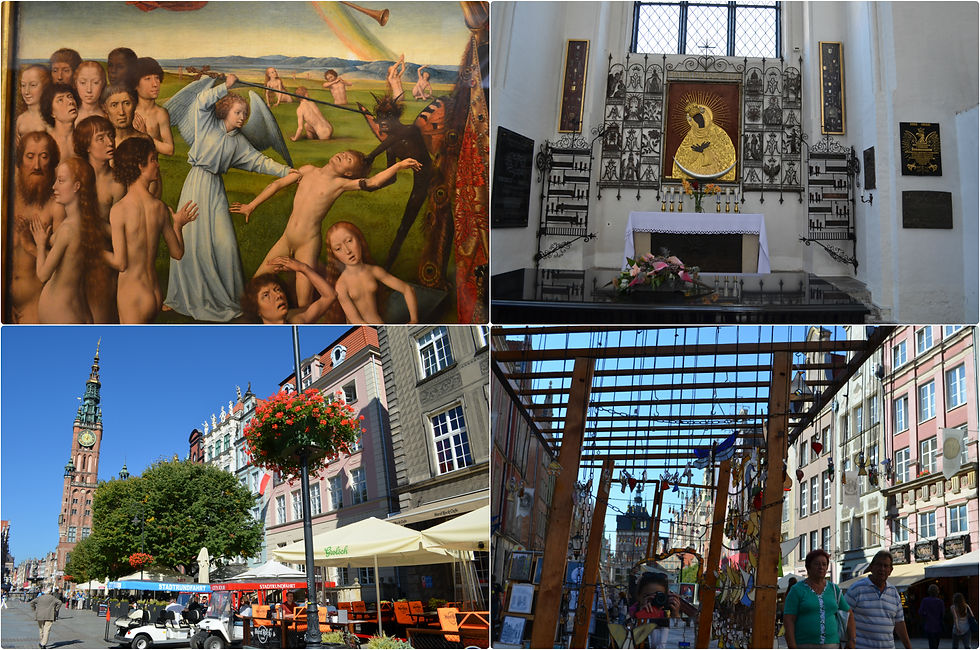
The first thing we did in Gdansk was to take a tour of the city. Our guide, the aptly named Kristoff, was great, but if everyone else was experiencing the same urges as I was, I feel bad for him… He first took us to the National Museum, located in a former monastery, where we saw a triptych called The Last Judgment painted by Hans Memling. I had never heard of it before but now it’s one of my favorite paintings because I could spend hours looking at the Bosch-esque goings on in it, what with the people being dragged to hell by monsters or elevated to heaven by angels or struggling in between. Then we went to the most curiously decorated building I may have ever been to, Artus Court, a meeting place for merchants originally built in the 14th century, damaged and rebuilt several times since then. A crazy, surrealist place that reminded me of Dali’s museum in Figueres, it could provide hours of entertainment with its ships hanging from the ceiling, its frescoes featuring 3D deer heads, its tall stove covered by tiles representing different people (among them, the emperor Charles V), its many paintings and carvings and knickknacks… Afterwards our guide took us to Saint Mary’s Church, the largest brick church in the world and, I would add, the one with the best natural light!
It was a very good tour. Kristoff was knowledgeable and courteous and helpful. What he told us was interesting and relevant. What he showed us was historic and beautiful. But I was only half there with him because what I really wanted to do, the entire time, was get away from the group and walk wherever my feet would take me, find a grocery store and get cookies and drinks that I could enjoy at any time and any place, not just at the dining hall between 7:00 and 8:00 or between 11:30 and 13:30 or between 17:30 and 19:30 or between 22:00 and 22:30! Movement! Food! Drink! Anywhere! Any time! Freedom! In the next few hours I was able to enjoy all that.
That afternoon I went by myself to the closest cemetery, the name of which I still have not found out, and spent an hour walking around and taking photos. What struck me most about it was the fact that almost all the graves, no matter how old they were, had flowers and even lit candles – someone had been tending to them recently!
On our second day we went to Stutthof, the first concentration camp built by the Germans outside of Germany and one of the last ones to close down. Before we got there, I had no idea how I would re/act. Now I still don’t know how I feel about visiting a concentration camp, about taking pictures, about writing about it. I will only mention 2 things: shoes and Spaniards. Upon their arrival, prisoners had their shoes taken away in exchange for wooden clogs. The leather from their shoes was used to repair other people’s, but their soles (souls!) were left in the camp in huge piles. One such pile was kept in one of the barracks we saw, right at the beginning of our visit. I don’t know what our tour guide said there and I don’t how the other people in my group reacted to it because as soon as I entered the room tears just started to pour out of my eyes, sudden, silent, burning, and I had to go look out the window until it was time for us to move on. In the next barracks I read copies of the files of the 2 Spaniards who were prisoners in Stutthof. Domingo was born in Tarragona in the year 1900, had bad teeth, big ears, and a wife called Mercedes, and was imprisoned for having uttered anti-German comments. Antonio was born in Lérida in 1914 and was a locksmith. No reason is given for his detention. Both were catholic. Both were detained in the year 1942. Antonio was released (whatever that means) within 6 weeks. There is no information about Domingo’s release.
That afternoon we made good use of our freedom again: went for a walk, bought some groceries, had fresh squeezed orange juice, and ate a delicious pizza. At one of the grocery stores we ran into a woman who works on the Explorer, frequently and sternly, at the card swiping point. I almost didn’t recognize her out of her uniform and sporting a wide smile.
What words come to mind now when I think about Poland, or at least about Gdansk? Cute, pretty, picturesque; crowded with tourists (many of them Spanish, French, and German); noisy (there is always someone performing or playing an instrument, or the city hall bells are ringing, or policemen riding motorcycles escort a car that transports newly weds and trails behind a bouquet of empty soda cans…); pierogis; Daniel Fahrenheit, Arthur Schopenhauer, Günter Grass, Klaus Kinski, and Lech Walesa (not a shabby list!); amber; flowers; color! And one more: relief!
***
Nuestro guía en Gdansk dijo en algún momento de nuestra visita que “Rusia no es un país; es un estado mental”. Dado cómo me sentí en San Petersburgo, ¿podría decirse que he estado en Rusia después de todo? Esta es una idea simplista, pero me pareció una buena transición entre la anterior entrada y esta.
Polonia. ¿Qué me venía a la mente cuando oía este nombre antes de esta mi primera visita? Parte de mi familia en EEUU es de origen polaco y, cuando mi hermana y yo los visitamos en Buffalo, en el estado e Nueva York, allá por la década de los 80 del siglo pasado, ambas fuimos a un Centro Polaco a aprender a bailar la polka. Comimos salchichas polacas y oímos muchos nombres llenos de kas y uves dobles y zetas. Estoy segura de que aprendimos algunas palabras en polaco, pero solo me quedé con una que nunca me ha servido de mucho: “dupa” (culo). También me enteré de que en los EEUU los chistes de polacos son el equivalente de los chistes de leperos en España. Más adelante, cuando España alcanzó por fin al “primer mundo” y la gente de otras naciones que estaban todavía por detrás en la carrera empezó a aparecer por allí en busca de un futuro, se podía ver a emigrantes polacos limpiando casas o recogiendo fresas (muchos de ellos en el mismo pueblo de Lepe, cerca de mi pueblo natal en la provincia de Huelva).
¿Y Gdansk? Tengo que confesar que lo tuve que buscar para este viaje, pero, cuando me di cuenta de que se trataba del nombre polaco de la Ciudad Libre de Danzig (que es alemán), se me vino al recuerdo una imagen de cuando estaba en el instituto: Estoy dando barzones en el piso donde vivíamos en Adra (Almería), repasando mis apuntes sobre la Segunda Guerra Mundial para un examen de Historia. Gracias a un truco de mi memoria (sin duda), llevo puesto un conjunto de falda y jersey verde de punto que me ha hecho mi madre y que es la causa de una batalla intestina entre las dos: me siento cómoda con él porque se me pega a mis recientes redondeces de mujer y me pica. Mi madre se ha pasado semanas haciéndolo y es verdaderamente bonito. Pero yo me siento expuesta y en carne viva. Y culpable. Ahora, ¡de vuelta al conflicto más importante! Nuestro barco atracó en la Península de Westerplatte, justo al lado de donde se pegaron los primeros tiros en 1939 y donde, el mismo año en que yo nací, se erigió un monumento en memoria de los soldados polacos que murieron intentando defender la guarnición. Podíamos hasta verlo cómodamente desde nuestro camarote.
Después de casi 2 semanas dentro de los límites físicos y mentales impuestos por la vida a bordo del barco y/o por nuestra visita a San Petersburgo, Gdansk me pareció la definición misma de la libertad, que sentí en el momento en que puse el pie fuera del Explorer. Después de escanear nuestras tarjetas de identidad del barco (algo que tenemos que hacer siempre que entramos o salimos), nos subimos a un autobús y fuimos en dirección de las cabinas de control de pasaportes, donde un guarda levantó la barrera e hizo señales al conductor para que pasara. No tuvimos que enseñar nuestros pasaportes en ningún momento (algo de lo que asumo se ocupó la tripulación de nuestro barco de alguna manera). En contraste, en Rusia, donde el barco estaba a 5 metros del control de pasaportes, tuvimos que hacer cola fuera, tiritando de frío e intentando no parecer culpables o temerosos y no mirar directamente a los ojos de los guardias con caras de pocos amigos que podían decidir, según les diera, si nos habíamos metido en problemas o no.
Lo primero que hicimos en Gdansk fue un tour de la ciudad. Nuestro guía, el bien llamado Kristoff (Cristóbal), era estupendo, pero si todos los participantes sentían los mismos deseos que yo, me siento mal por el pobre hombre… Primero nos llevó a Museo Nacional, ubicado en un antiguo monasterio, donde vimos un tríptico llamado El último juicio, pintado por Hans Memling. Nunca había oído hablar de él, pero ahora es uno de mis cuadros favoritos porque podría pasarme horas mirando el ir y venir, a la manera de El Bosco, de gente a la que arrastran monstruos hacia el infierno o elevan ángeles hacia el cielo o se debate entre los dos destinos. Después fuimos al edificio con la decoración más curiosa que haya visto jamás, el Salón de Arturo, lugar de encuentro de mercaderes que fue construido originalmente en el siglo XIV, destruido y reconstruido varias veces desde entonces. Un sitio extraño y surrealista que me recordaba al museo de Dalí en Figueres, seguro que daría para largas horas de esparcimiento a quien quisiera fijarse bien en los barcos que cuelgan del cielo, los frescos con cabezas de ciervos tridimensionales, una estufa altísima cubierta de cerámica en la que se ven bustos de personas (entre ellos, el del emperador Carlos I), un montón de pinturas y tallados y adornos… Después nuestro guía nos llevó a la Basílica de Santa María, la iglesia de ladrillo más grande del mundo y, yo añadiría, ¡la de mejor luz natural!
Fue una vista estupenda. Kristoff sabía mucho, era amable y nos ayudó un montón. Lo que nos contó era interesante y relevante. Lo que nos mostró era histórico y bello. Pero yo estaba allí con él solo a medias, porque lo que realmente quería hacer, todo el tiempo, era alejarme del grupo y andar hasta donde me llevaran mis pies, buscar un supermercado y comprar galletas y bebidas que luego pudiera comerme a cualquier hora y en cualquier lugar, ¡no solo en el comedor del barco entre las 7:00 y las 8:00 o entre las 11:30 y las 13:30 o entre las 17:30 y las 19:30 o entre las 22:00 y las 22:30! ¡Movimiento! ¡Comida! ¡Bebida! ¡En cualquier sitio! ¡A cualquier hora! ¡Libertad! En las horas siguientes disfruté de todo ello.
Esa tarde me fui sola al cementerio más cercano, cuyo nombre aún no he conseguido averiguar. Allí me pasé una hora paseando y haciendo fotos. Lo que más me sorprendió fue el hecho de que casi todas las tumbas, independientemente de su antigüedad, tenían flores y velas encendidas. Alguien se estaba ocupando de ellas.
En nuestro segundo día fuimos a Stutthof, el primer campo de concentración que los alemanes establecieron fuera de Alemania y uno de los últimos en cerrar. Antes de llegar allí no tenía ni idea de cómo actuaría o reaccionaría. Ahora aún no sé lo que siento sobre la idea de visitar un campo de concentración, de hacer fotos, de escribir sobre ello. Solo voy a mencionar 2 cosas: zapatos y españoles. Cuando llegaban los prisioneros, les quitaban los zapatos y les daban unos zuecos de madera. La piel de los zapatos se usaba para arreglar los zapatos de otras personas, mientras que las suelas (“soles” en inglés, que se pronuncia como “souls”, que significa “almas”) las dejaban en el campo amontonadas en pilas enormes. En uno de los primeros barracones que visitamos había una de estas pilas. No sé lo que dijo nuestra guía allí y no sé cómo reaccionó el resto de la gente que iba en el grupo, porque tan pronto como entramos se me cayeron lágrimas inesperadas, silenciosas, calientes, y me fui a mirar por la ventana hasta que llegó el momento de pasar a otro barracón. Allí leí las copias de las fichas de los 2 españoles que estuvieron presos en Stutthof. Domingo nació en Tarragona en 1900, tenía malos dientes, orejas grandes y una mujer llamada Mercedes, y lo metieron allí por haber pronunciado comentarios anti-alemanes. Antonio nació en Lérida en 1914 y era cerrajero. No se da el motivo por el que lo detuvieron. Ambos eran católicos. Ambos fueron detenidos en 1942. A Antonio lo sacaron de allí (no sé qué significa eso) a las 6 semanas. No hay información sobre lo que le ocurrió a Domingo.
Esa tarde volvimos a hacer buen uso de nuestra libertad: dimos un paseo, compramos comida, nos tomamos un zumo de naranja natural y comimos una pizza deliciosa. En una de las tiendas nos cruzamos con una mujer que trabaja en el Explorer, con frecuencia y seriedad, en el punto de escaneo de las tarjetas de identidad. Casi no la reconocí sin el uniforme y con una amplia sonrisa.
¿Qué palabras se me vienen a las mientes ahora cuando pienso en Polonia, o al menos en Gdansk? Mona, bonita, pintoresca; llena de turistas (muchos de ellos españoles, franceses y alemanes); ruidosa (siempre hay alguien actuando o tocando un instrumento, o las campanas del ayuntamiento están sonando, o hay policías que escoltan en moto algún coche que transporta a recién casados y arrastra detrás un ramo de latas de bebidas…); pierogis (una especie de empanada polaca); Daniel Fahrenheit, Arthur Schopenhauer, Günter Grass, Klaus Kinski y Lech Walesa (¡no está mal la lista!); ámbar; flores; ¡color! Y una cosa más: ¡alivio!




Comments